Monday, June 23, 2008

Composting Fury

As an inveterate apartment dweller for all of my life, the idea of a compost heap sounds as magical as a tomato garden, as wondrous as home-cured salumi and as elusive as the wild mushroom of immortality. Okay, so I'm getting carried away. Composting is probably easier than finding lingzhis, but never having lived in a house with a compost capability, it has always sounded thoroughly exotic to me.

Laugh if you like, but off and on, over the past several years, I've expressed an ardent desire (usually it comes out as a whine) for a compost bin. It often comes with an equally whiny plea for a garden...and a pony... and world peace. However, more recently I've revisited the idea, spurred on by websites that offer hints on apartment-scaled composting, undeniably attracted by the thought of a bin that would fit under our sink. It still seemed impractical and we had many unanswered questions about bug control and/or smell, more research... more thinking... more discussing... But at last, I was finally put right over the edge this weekend by the innocent-looking little shelling pea you see above.

I love shelling peas, they make a great snack, come prepacked in their own individual wrappers, taste sweet and are a nice healthy alternative to my usual junk food. However, as with many other kinds of beans, you get somewhere between 5 and 8 peas per pod, and throw away 90% of the bulk. To a landfill. If you're not composting.

Over the weekend, we were so pleased with our healthful approach to life, visiting the Ferry Plaza farmer's market for vegetables and fruit, making our own peach ice cream, our own smoked salmon salad, a Meyer lemon snack, munching on shelling peas. Then on Monday I looked into the 8 gallon trash can in our kitchen and had a moment. A rampaging moment. Peach peels, eggshells, coffee grounds, dead flowers, leaves off my plant, lettuce cores, and pea pods-- so many pea pods.

It's a little gross, but yes, I dug through our garbage and sorted out what was compostable from what was not and LO! Nearly EVERYTHING belonged in compost.


Food scraps and paper tissues and paper towels filled a bag's worth of space and the non-compostable stuff? Barely a handful.

"This is NOT going to a landfill!" I muttered over and over as I rooted around in every trash can in the house. "Hey, we're supposed to be recycling CDs! And what's this battery doing in here???"

I'm not so much turning into Lola Granola, as the Raging Compost and Recycling Fury.

I started re-evaluating the non-compostables I'd pulled from the trash. Cat food can tops (recyclable), a Straus Dairy plastic top (marked plastic type 4--recyclable), plastic tabs from the same (recyclable), aluminum top to the frozen juice can (recyclable), champagne bottle cork (recyclable), wire top to same (recyclable). When I finished, and I kid you not, we had true garbage that weighed in at 6.25 ounces. Compost bag? About 12 pounds.

I am horror-struck. 97% of my garbage could be composted. All my wastrel life, how much of my garbage that could have been reclaimed is now living in a landfill?

Originally as I proposed the "let's have a compost basket in the kitchen," I had thought that a small basket would be enough to hold our compostables for a week, and that we'd then haul it down to Whole Foods and chuck it into their giant commercial-sized compost dumpster. Given the "12 lbs. versus 6.25 oz." proportions, we decided to flip things around, and our regular garbage can is now happily lined with a compostable biobag, and the little basket is ready for any garbage we can't recycle, reuse or renew any other way.

Of course, I'd still love to have my own little heap of quietly decomposing materials under the sink or in a corner, but it looks a fair way off yet. The Nature Mill Automatic Composter is very cool, but at $300 it's too expensive. The 10-20 gallon tub method described here is attractive, but still too large to fit under our sink, plus there's the insect problem. And every other kind of compost pail we've seen completes its description with "then simply take it out to your yard and dump the compost onto your outdoor heap." Oh sure. My outdoor heap. In that yard I don't have, behind the house I don't live in.

So for the nonce, we shall be collecting 97% of our garbage in our biobag and hauling to Whole Foods. After all, as I pointed out to my Omnivore, if we're lucky enough to live in a city with one of the most ground-breaking (literally) composting programs in the nation, we should take advantage of it.

How about it folks? Where is your 97% going?

As for me, I'm off to shell a few more peas...

================================
Interesting links:
-- San Francisco's Composting Program
-- Jepson Prairie Organics: SF composters, see where your goodies go.
-- 163 things you can compost: Not all of this makes the cut for the SF city composting program of course... but for the home composter (Bat guano?)
-- EcofindeRRR: where to recycle or dispose of just about anything (Bay Area only)

Sunday, June 22, 2008

Hot times in the City

It really was hot here. Here. I mean in San Francisco. No, really, stop laughing at me... It's not funny. I got an actual real-honest-to-goodness sunburn.

'Course it's not hot right now. Overnight it dropped forty degrees and the fog rolled in. Now I'm wearing the socks and a woolly sweater that would have seemed unthinkable yesterday. Welcome to Summer Solstice in San Francisco.

But I do love those gorgeous clear blue days -- it almost makes it seem like we're living in California, that is, the kind of California you see in movies.

We were up early for a Saturday morning and since neither of us had anything scheduled for once (!!) we ventured out to run some food errands. As usual on days like this, pretty much the entire day revolved around the question "What are we going to have to eat?" Sometimes I think we're hobbits. Under ordinary circumstances, (i.e. when we're not ill) we finish breakfast and then we're on to second breakfast. "What about elevenses? Luncheon? Afternoon tea? Dinner? Supper?"

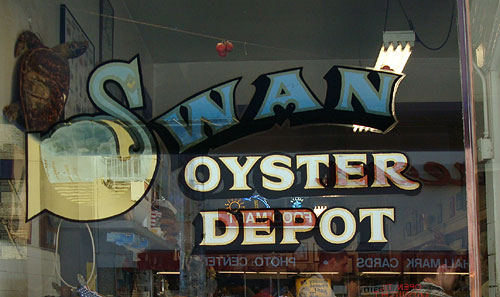
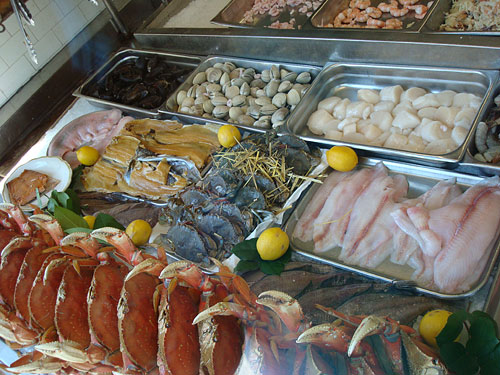
First stop was the eternal fave, Swan Oyster Depot (1517 Polk St at California, 415-673-1101) It's been featured in so many magazines and shows now that I guess it's not a secret anymore, but it's still the best place to go to get fresh fish, crab, shrimp, oysters, you name it.

The 96-year old Swan's is still run by the same family, the Sanciminos. The guys are terrifically chatty and have tons of great ideas if you're ever at a loss as to how to cook the fish you just bought. My Omnivore went in to order some salmon for us to smoke in our stovetop smoker,while I pressed my little nose against the window and marvelled at the scallops.

Off to the Embarcadero for a Saturday morning round at the Ferry Plaza Farmers Market. We arrived pretty late in the morning, which always means the place is just completely overrun. For a second it looks vaguely like Eisenstein's "Battleship Potemkin"-- old woman with packages, baby carriage, bags, mother, baby carriage, saber-wielding Cossack--everyone, get out of my way!

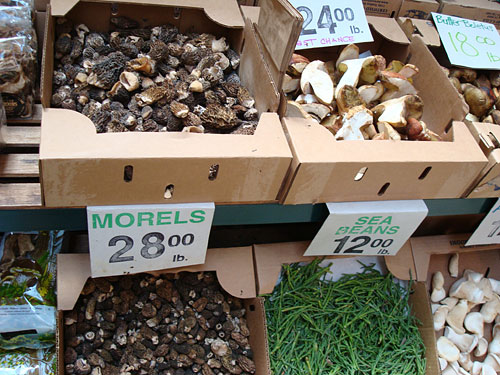
Ahem. Neverthless, it doesn't prevent me from enjoying walking around ogling the produce. Note Far West Funghi not only has porcinis (the one small box seems sad compared to the vast mounds we saw in the San Lorenzo market in Florence), and sea beans (the same samphire that I so desperately searched for to add to our Water course when we made our Elements dinner).

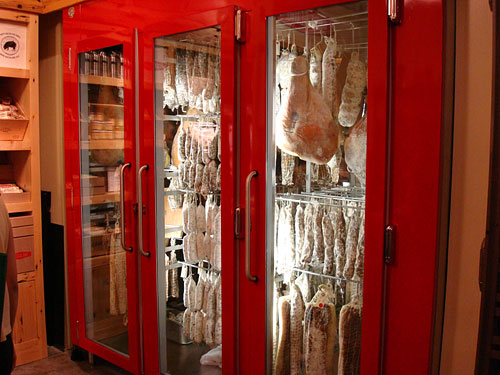
Newly opened on Sunday is Chris Cosentino's Boccalone, selling his own line of cured salumi, including the Orange and Wild Fennel, plus pork lomo, guanciale and prosciuttos.

"Tasty Salted Pig Parts" is their motto. You can find Boccalone in pockets around the city including Cosentino's place, Incanto as well as Falletti's, but it's nice to know you can come down here to get exactly what you need.

There's also something viscerally pleasing about peering into the fridge and staring at all that lovely salumi.

Well-lighted, I notice. Ah, the Theah-tah...

Outside, the action is frenzied and sweaty as the crowd of hungry souls swell to purgatorial proportions and the heat crawls up to inferno. We wander around to some of our favorite proprietors though, including Dirty Girl, where we pick up some of the cutest baby turnips you've ever seen, Frog Hollow to test out Gold Dust peaches for some much-needed peach ice cream, and Della Fattoria, to say hi to Ed, who plies us with goodies, including an absolutely delectable almond financier. Perfect for our Elevenses. We'll catch up with them next weekend when we head up to the Della ranch for the Bread Expedition.

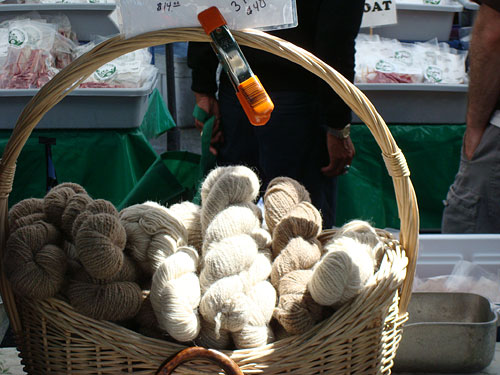
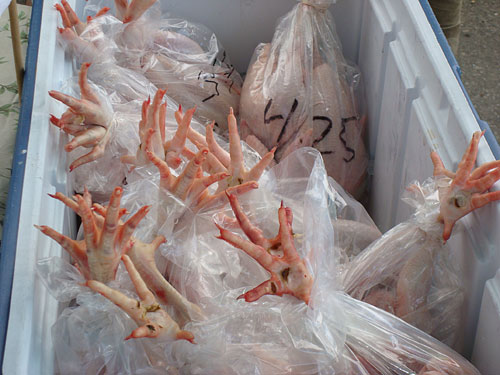
Over at the Marin Sun Farms stand, I'm entranced by the basket of homespun yarn in natural colors. Do I have time to pick up my knitting again? Hmm... Then my attention is drawn down to the coolers below the basket.


Pastured chickens, feet up in a curious forest of claw-branches.

We're sorely tempted but try to focus in. We have a plan for dinner, and we have to stick to it. But, boy, those chickens are probably super-tasty.

Sigh.

Outside of their tent, they have a handy diagram of a cow and the cuts of a cow, so you can point to what you want when conferring with the butcher.

"If you please, something from the butt-cheek region, my good man..."

After some arduous food testing, we were ready for luncheon. We pop our goods into the handy cooler in the car and head up the street to Gordon Biersch for a beer/margarita and a burger with garlic fries. Oddly enough, I've never eaten there before, although I do admit that I've consumed my fair share of garlic fries at the ballpark.

Things were slightly surreal at the "Check in with the Hostess" desk. The place wasn't terribly crowded, we were the only ones waiting at the door and the cafe had several open tables in the back, but the hostess duly wrote down our names and handed us the remote control buzzy-thing. "I'll buzz you when your table is ready. Oh, I see-- I guess OUR table isn't ready, it's just those OTHER tables that are ready.

So we stood there, trying not to stare as she threaded her way through the empty tables and then brushed past us, headed back to her desk where she hit the button that set off the buzzy-thing. Feeling more than a little silly, we walked over to the desk and said, "Um, you buzzed?"

Wth a perfectly straight face, she took it, turned off the buzz, and then led us to one of those empty tables.

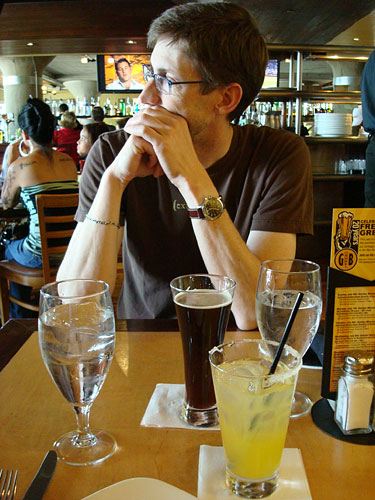
My Omnivore, deep in contemplation of...

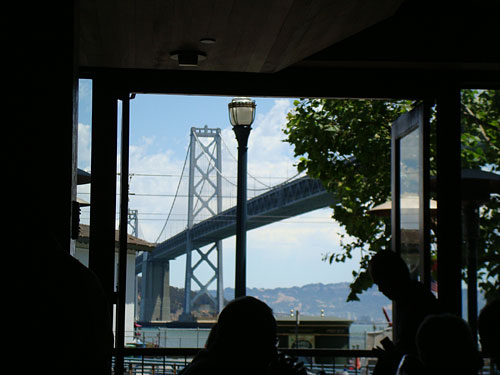
The Bay Bridge. Yeah, the view is pretty nice from there.

Luncheon over, we turn our attention to afternoon tea.


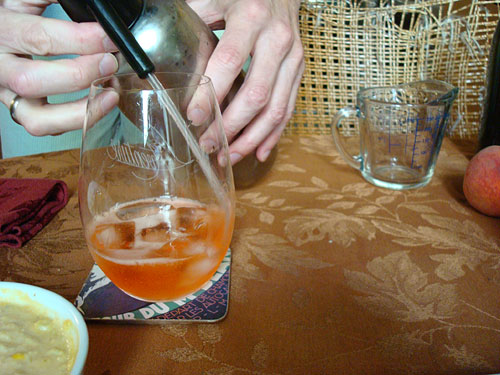
Back at home, the Aperol comes out and the nice splashy refreshing spritzes hit the glass. I think this is one of our favorite concepts brought back from Italy. It's made that much better by the zing of seltzer from our Liss. I love that thing.

Some addictive shelling peas make a not-too-guilt-inducing snack. I could eat several pounds of them, and um, I think I did.

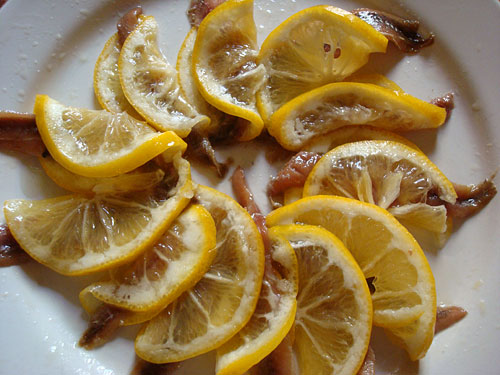
To this we added a little antipasto of anchovies wrapped in Meyer lemon slices.

The anchovies this time seem super salty -- and the whole effect of this power-packed tidbit is to make my face and my brain reel wildly--SALTY! SOUR! SALTY! SOUR! I CAN'T STOP EATING THEM!

And onward to dinner!

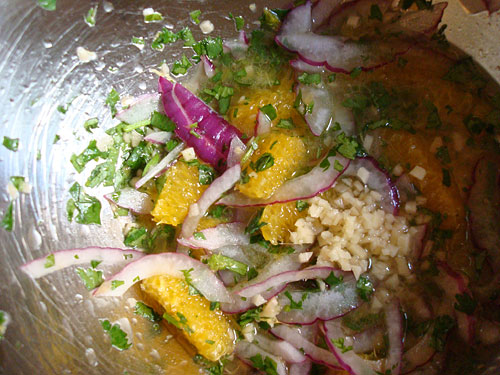
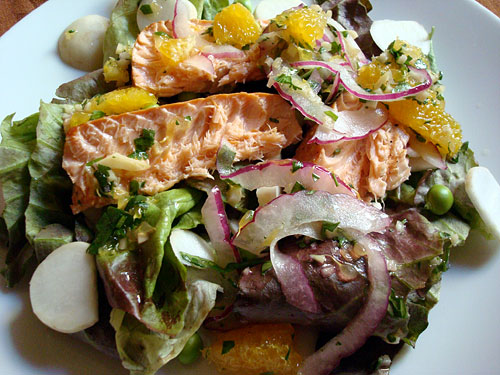
A little vinaigrette of orange (supremed very neatly, if I do say so myself), a 1/4 cup of thinly sliced red onion, a teaspoon or so of chopped fresh ginger, some chopped cilantro, a couple of tablespoons of rice wine vinegar, a couple of tablespoons of vegetable oil, bit of sugar, salt and pepper and mix well with your fingers.

We put this over some salmon smoked with alder chips, torn butter lettuce, slice baby turnips and more shelling peas.

A perfect dinner for a hot night.

Now, about supper...

Monday, June 16, 2008

Boola, boola: Yummy Multigrain Boule of bread

Martha Stewart. She does know her food, I'll say that. She must have meticulous recipe testers too, because if you follow her instructions carefully, you get results, believe me, you get results.

Flush with my recent successes in Bread-Land, I decided to try a more flavorful Multigrain Boule, which Martha had in a recent issue of Living. Results blew the top off, so to speak...

I used the ingredients pretty much as listed on the site, but being a little lazy today, and also still recovering from being sick over the weekend, I didn't bother to weigh the flours, but just used cup measures. It didn't seem to affect the recipe adversely. I also feel like I'm starting to get the hang of that "feel of the dough." When it gets a certain elastic smoothness, you can feel it under your fingers, and you know if it needs more water or more flour to balance things out.

I remember long ago, a friend's blind grandmother shared some sourdough starter and advice with me (both of which I've sadly lost). She was an inveterate breadmaker though, baking bread every week, even though she had lost her sight and couldn't (obviously) measure things carefully anymore. Years of experience molded into her hands could tell her though how much flour or water to add.

Making this bread is a long-ish process. I made the starter last night at 8 pm, so I could start the bread this morning, as the starter takes 12-15 hours to develop. There are three risings, not including the initial 20 minute autolyse rest, and then the bread bakes an hour, so it's an all day prospect. Letting the bread make its last rise in a floured towel set in a colander gives it a great shape. I love that trick.

Apparently though, my boule-shaping technique was not so great. I guess I needed to pinch the seam on the bottom shut a little more firmly, because I got an "alien-brain" blowout on the side on my boule.

It didn't affect the flavor, though, which was fantastic. The rye and the wheat germ gave the crust a nice crackly crunch, and the seeds and mix of flours had a terrific hearty flavor. This might become my new favorite bread.

Have I mentioned that we're planning a trip up to Della Fattoria's farm in the next couple of weeks for dinner and some bread making? Very timely. I need some tips on perfecting the boola-boola...

Wednesday, June 11, 2008

Bread Riots

They're having pasta strikes in Italy, tortilla riots in Mexico -- in case you haven't noticed the world's cupboards are starting to look bare... Here at home, my eyebrows go continually higher every time I buy a loaf of bread. How can it be $3... no, $4.... wait, $5 a loaf? They should just put a digital plaque instead of a sticker on each of the packages. Then the price can change as fluidly as the price of an airplane ticket (another topic for another time).

I'm striking out on my own. For a while I had a bit of a bread-making obsession, then I wound up being too busy to fit in the weekly bread-making. Well, I'm still busy (thus my lack of recent posts!) but now I'm making the time to do the household bread-making...plus butter-making... plus fizzy water-making...and ice cream-making...

We live in San Francisco, so I thought,"Hey, even if I can't have a garden, I can't have compost in my apartment, I can't even properly grow catnip, I can at least harvest the wild organisms of the air." So I set about making a sourdough starter.

There are a ton of instructions out there on harvesting and caring for the wild Lactobacillus sanfrancisco. I used Mike's process with pretty good results, I haven't exhaustively tested all those other though. Maybe if I get good at this bread thing... One of the most useful tips I read, though, was that the starter should be made/kept only in plastic or glass. I've made it in metal bowls before and always had trouble, but apparently the metal inhibits the micro-critter growth.

I did attempt the Berkeley Sourdough recipe from Boudin Bakery, but I seem to have incorporated too much white whole wheat and not enough bread flour because it mixed up dense, and was even denser after all those risings and bakings.


I've got hungry mouths to feed around here though, including my own. So I set aside the sourdough starter (don't worry, I'm feeding the beast in our fridge) and instead, made an interim batch of sandwich bread, courtesy of Farmgirl Susan.

What I love about Susan's recipe is that it's clear, simple to follow and the results are really terrific. She explains the steps that have always mystified me (why the little 20 minute rest before the first big rise? Why wait to put the salt into the dough?) Plus she's got some ADORABLY cute lambs on her farm in Missouri.


I followed her recipe, only subbing in some of the King Arthur White Whole Wheat flour for some of the bread flour, and we were rewarded with lovely light happy loaves.

I actually don't own enough loaf pans, and so some of the dough wound up in mini loaf pans, which produced such cute little poofs, that even My Omnivore couldn't restrain a little squeal of delight.

They are the perfect snack size and make for painfully cute mini-PB&Js-- you could eat, um three and not even blink.

I think I have to incorporate mini loaves into every batch now.

I'm also thinking I might need a wooden bread bowl. Okay, alright, so I don't need one, per se, but they're awfully pretty and they might help me make better bread... Rationalizing, rationalizing...

For one or two days it was actually hot, and we relived our Italian trip briefly by making ourselves Spritzes with Aperol (1 part), Prosecco (2 parts) and a splash of seltzer. Garnish with a slice of orange and you're in heaven.

Aperol has become easier to get I think, still not as popular as Campari, but I like it a lot better, as it's not as bitter and has a great citrusy floral aroma.

It's not the case right now, but at the time it was too hot to cook. (Now the fog is veiling the tops of nearby high rises and a fell wind is whipping the trees sharply off of vertical. Look for the Four Horsemen of the Apocalypse to come riding out at any moment)

On the four days out of the year when it's hot in San Francisco though, I prefer not to cook, and a plate of mixed cheeses with some fried sage leaves is just the ticket. Clockwise from the bottom left: Slices of Parmagiano-Reggiano, Wensleydale, St. George, a goodly dollop of our favorite SF Drake from Cowgirl, and in the center, some Fourme d'Ambert.